Hospitality – The Paid Social Guide
- Paid Social
- Hospitality

The customer journey of a traveler can be simplified and broken down into 4 phases: inspiration, research, booking and in-destination stay. The behaviour is repetitive and a new, or pre-existing, inspiration phase starts to plan the next trip. The phases have one thing in common – people use social media throughout their journey.
Hospitality is a highly competitive industry with a lot of actors. Hotels are not only competing with direct competition, as in other hotels, but also online travel agencies (OTA). Marketing becomes essential to maintain a high occupancy rate, but even more to acquire customers to loyalty programmes – building lifetime value. The industry is relatively mature in managing Google Search, which naturally is the most competitive landscape in a marketing mix. On the other hand, the paid advertising on social media platforms is relatively low. It opens the door to build a competitive advantage and drive impact before the search happens – this article tells you how to do so effectively.
The hospitality industry has a lot to learn from E-commerce
We have reviewed the biggest social media platforms to get an understanding of how well the industry leverages the marketing solutions available. The key insights are that:
- Marketing dollars are primarily invested in reach and/or traffic objectives. Optimizing towards signals, such as room availability or bookings, is rare.
- The standard of tracking is poor, limiting the opportunity to leverage signals. While tracking is often implemented, it is far away from optimized.
- The product adaptation is among the lowest we have seen. Hotels are not leveraging marketing features that have a significant impact on their results.
- Creatives are to a large extent not optimized, meaning that formats are not adapted to the placements of the platforms – creating a bad brand experience.
- Audiences compensate for poor creative assets. Narrow audience settings limits scale in an attempt to improve the relevance in targeting.
Together, these insights indicate a low marketing maturity and a significant opportunity for companies who make an effort to master their paid socials strategy.
Mindset: The strategic thinking necessary to drive effect
The customer journey of a traveler accounts for +30 touchpoints and being present early in the journey can have a significant impact on the price paid to acquire the customer. Causal impact studies conducted by NoA Connect shows that combining lower and upper funnel focused campaigns on Meta drives 1.5x more incremental revenue compared to brand or performance alone. For a hospitality company with a sufficient marketing budget, 15-25% is the optimal investment in upper funnel to maximise return on investment.
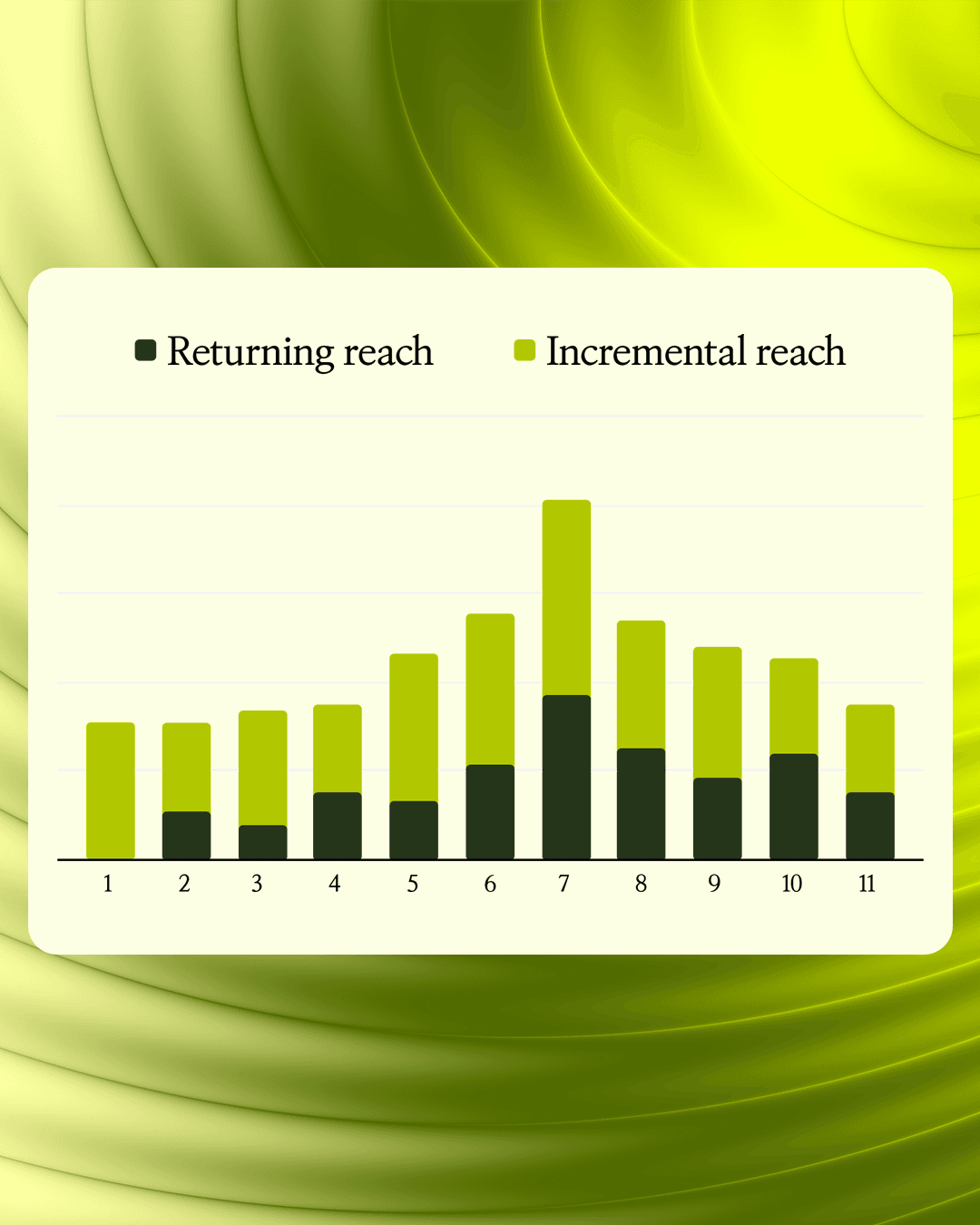
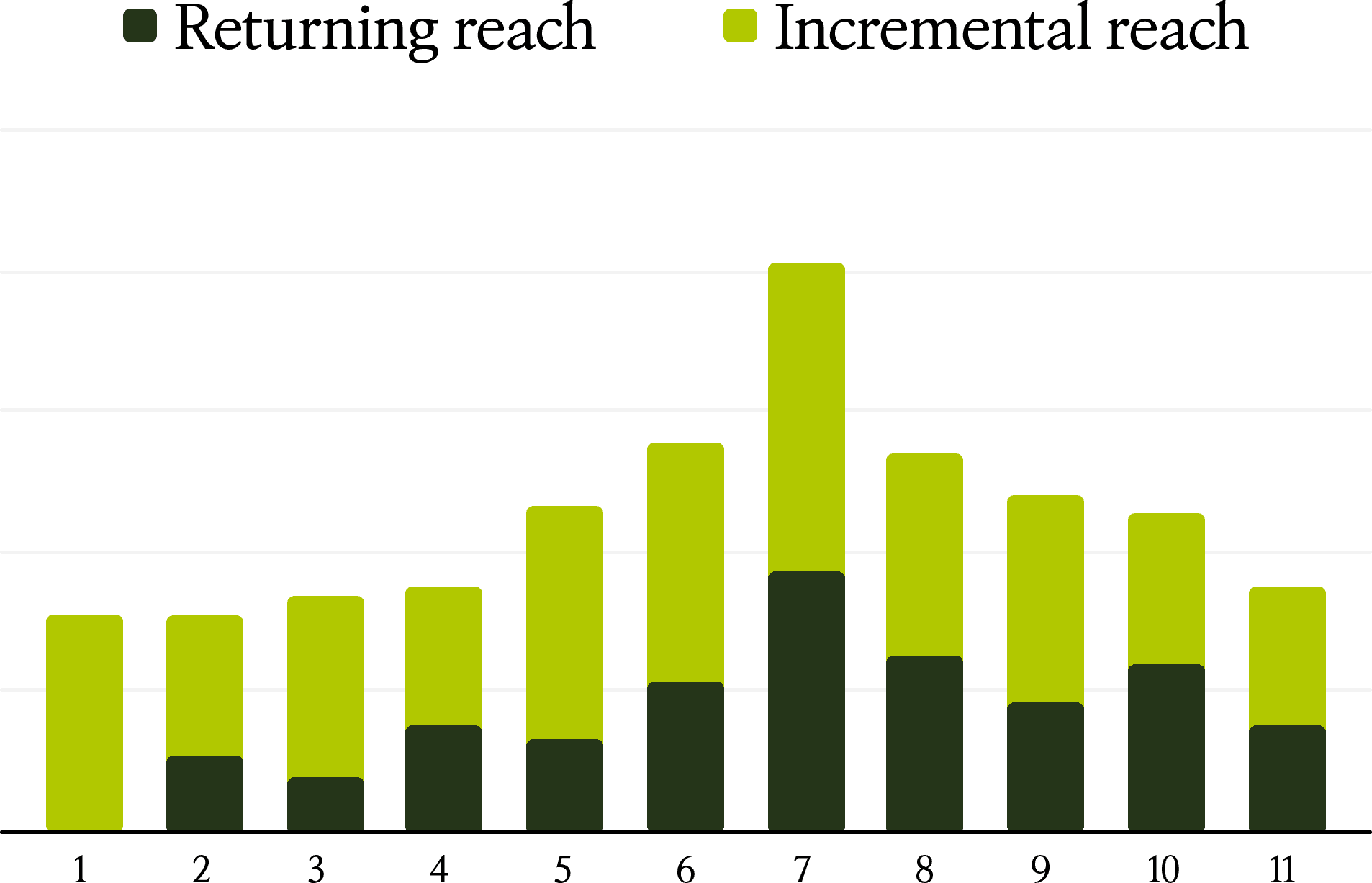
It is important to understand that social media platforms will have a good understanding of where people are planning to travel early in their journey: partly because of how they use the platforms to research, partly due to how well they are tracking user behaviour through outside of the platforms. For an advertiser, it means that signals and creatives are more important than audience settings. Target a broad audience and concentrate your efforts on providing the system with the best possible information. The chart below shows how well the system finds new users who are interested in travelling to a destination, where frequency is built towards an audience who are prospected throughout their customer journey.
When segmenting upper and lower funnel, you can assume that a vast majority of reach will represent different groups of users:
- Reach objectives will reach people who are early in their customer journey.
- Optimizing towards research on site will reach people who know where they are going.
- Optimizing towards bookings will reach people who are ready to complete their booking.
Building a strategy that works will require tests across these objectives, where top-down or bottom-up should be decided based on your marketing budget and defined business goals.
Creative: From hotel room to an invitation to the experience
Customers want an experience, not just a room. The difference between a $$$$ and a $$ hotel, good and a bad stay, is the observed experience from the visitor. Yet, most hotels use standardised room images as creative assets in their marketing on social media. Images from the Rooms & Rates part of the website become the fallback when creating assets is too much to ask for. The assets say very little about the experience and are often not photographed and edited for mobile-first.
Content is the most important element in teaching algorithms who to serve the ad to. Relevance and scalability is dependent on good content. Production costs are lower than ever and is no longer an excuse for bad creatives. What companies save in production costs are lost multiple times in booked revenue due to poor performance. Studies conducted by NoA Connect shows that a good mix of content drives 4x stronger incremental results compared to single images.
What drives performance?
- Social-first is essential: Phase, sequencing, video length and call to action need to be adapted to the fast-phased environment.
- Destination: Creating an association between the hotel and the destination.
- Characteristics: Culture, social spaces and hotel niche drives preference.
- Sound-on: Leverage sound to build the feeling your hotel stands for.
What helps you reach the right audience?
Ensure you combine production (video, image), social-native (creator, influencer) and dynamic ads (catalogue, collection) to be visible across all placement and adapt your communication to different user preferences.
Signal-driven: The features you should explore to unlock scale
Hospitality can learn a lot from E-commerce in the tracking setup. The customer journey one site is similar, which means that the infrastructure of standard events can be applicable.
- Page views: Triggers on all pages
- View content: Triggers on hotel pages
- Add to cart: Triggers when rooms and dates are explored
- Check availability: Triggers when the checkout is initiated
- Purchase: Triggers when a booking is completed
When the tracking follows best practices, the biggest impact is driven by your hotel catalogue. Catalogues are frequently used by E-commerce brands but very few hotel brands know that Meta have built a custom solution for travel. It collects detailed information about your hotel to offer hyper relevant targeting. There is no other product on the platform that can bring the same relevance and drive better efficiency. Not having a catalogue is like telling Meta that you want people to come to your hotel without providing an address.