The Shift: Search Engines to AI Travel Advisors
- Article

Not long ago, planning a trip meant opening a dozen browser tabs: flights on one, hotels on another, reviews scattered across TripAdvisor, Reddit threads, and travel blogs. Today, that process is collapsing into a single conversation.
Large language models (LLMs), the technology powering tools like Google’s AI Mode, ChatGPT, and others, represent a fundamentally different kind of search. Traditional search engines match keywords to web pages and return a list of links. LLMs understand context, intent, and nuance. Ask a traditional search engine “where should I go in July with low rainfall and good snorkeling?” and you’ll get a list of articles to read. Ask an LLM the same question and it gives you a direct answer: tailored, conversational, and ready to refine.
This shift from information retrieval to intelligent assistance is reshaping how travelers discover, plan, and book their experiences. And it is happening faster than most hospitality brands realise.
Research: From “100 Tabs” to One Prompt
The most immediate change AI is bringing to travel is in the research phase. Travelers are increasingly turning to conversational AI to do what used to take hours.
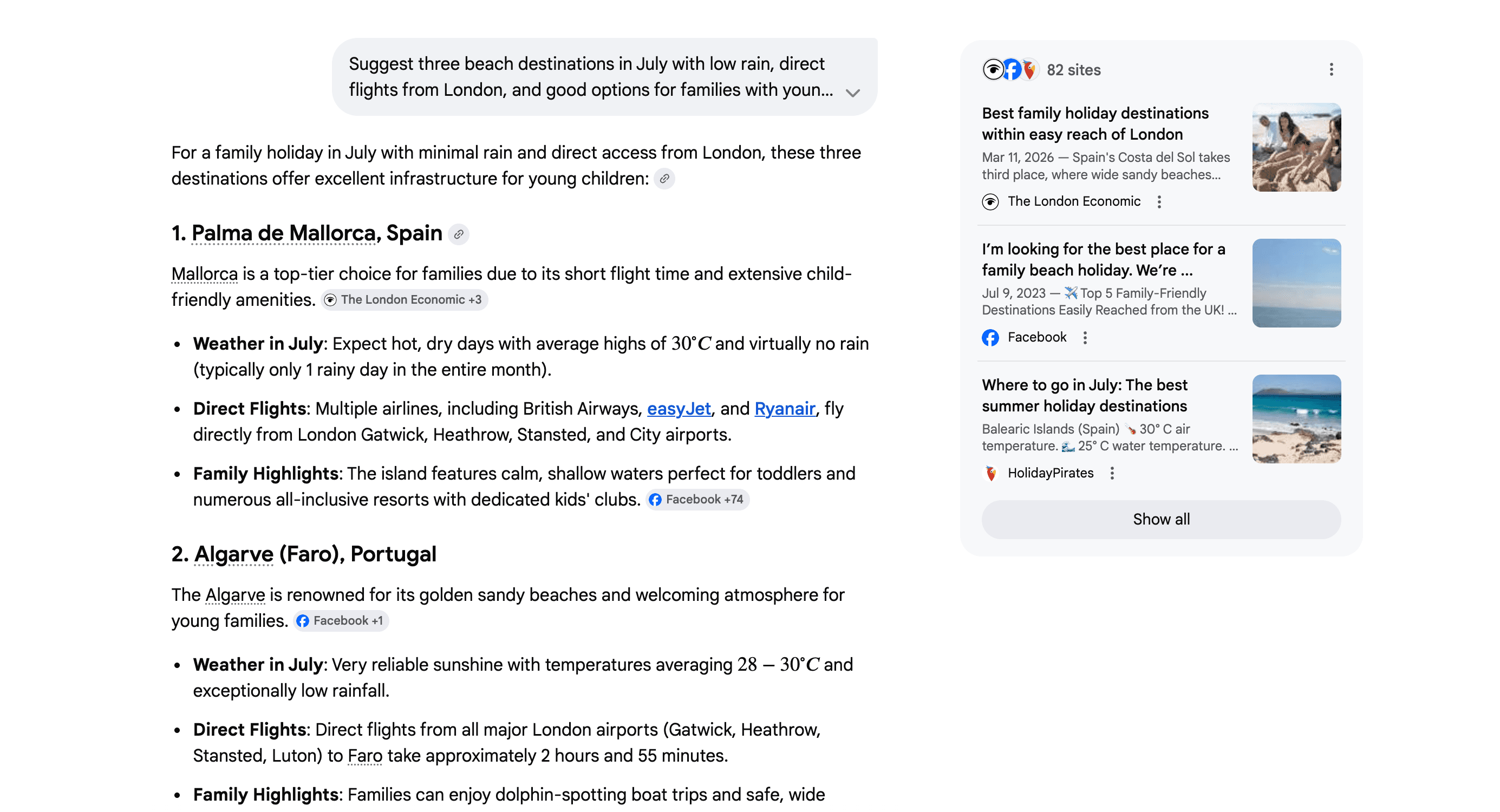
A single prompt like “suggest three beach destinations in July with low rain, direct flights from London, and good options for families with young children” now returns a structured, reasoned recommendation rather than a list of links to trawl through. This kind of conversational discovery compresses what was once a multi-session research process into minutes.
Beyond single queries, AI systems are beginning to develop memory across sessions and brands. Rather than re-entering preferred room type, bed type, or loyalty membership every time you search, AI travel tools are building persistent profiles that carry over automatically. Your preference for high floors, a king-size bed, and quiet rooms becomes part of every search without any extra effort.
AI is also transforming how travelers evaluate options. Instead of reading through hundreds of reviews, AI can summarise them into clear “pros and cons” and “best for” categories: best for couples, best for business travel, best for light sleepers. It can also surface risks that travelers might otherwise discover too late, such as ongoing construction nearby, mandatory resort fees buried in the fine print, or cancellation policies that are easy to misread.
Google’s own research into LLM-based trip planning illustrates the depth of this capability. Their hybrid system combines Gemini’s ability to understand qualitative preferences (like “avoid touristy spots”) with real-world data like opening hours and travel times, producing itineraries that are not just appealing but actually feasible.
Planning: Itineraries Built Around You
Choosing a destination is just the starting point.
Modern AI travel tools can generate day-by-day itineraries that reflect a traveler’s specific pace, interests, accessibility requirements, and dietary needs. A solo traveler who wants a slow-paced cultural trip through Kyoto gets a very different itinerary than a family of four looking to pack in theme parks and beach days in the same city.
What makes this genuinely powerful is dynamic planning. AI can optimise routes based on geography, account for opening hours and peak crowd times, and offer contingency plans for when things don’t go as expected. The best implementations go beyond static itinerary generation, dynamically adjusting routes, accounting for opening hours and crowd patterns, and offering alternatives when plans change.
Canvas, Google’s new travel planning feature within AI Mode, takes this a step further. It gives travelers a persistent workspace where plans can be organised, adjusted, and refined over time rather than rebuilt from scratch with each new search.
Booking: The One-Cart Experience
Research and planning have traditionally been separated from booking by significant friction: switching platforms, re-entering details, and comparing prices across different sites. AI is beginning to close that gap entirely.
Through deep API integrations with major travel and hospitality platforms, AI tools can now move from recommendation to reservation within the same interface. Google’s AI Mode already supports agentic booking for dinner reservations through OpenTable, Resy, and Tock, meaning the AI doesn’t just suggest a restaurant — it books the table. Flight and hotel booking is in active development, with confirmed partnerships including Booking.com, Expedia, Marriott International, and IHG Hotels & Resorts.
The destination is what might be called the “one-cart experience”: a traveler describes a trip, the AI builds an itinerary, and then facilitates booking the flight, airport transfer, hotel, and restaurant reservation in a single mediated transaction. IDC forecasts that by 2030, 30% of travel bookings will be executed by AI agents, a signal that this is not a distant future but an infrastructure being built right now.
What This Means for Hospitality Brands
For hotels, airlines, restaurants, and travel operators, the rise of AI-mediated travel creates both urgent challenges and significant opportunities.
Discoverability is being redefined. Accurate, complete, and machine-readable data has long been a technical SEO fundamental. The difference now is that it determines whether a brand is visible to AI agents at all. AI agents evaluate options based on the accuracy, completeness, and machine-readability of a brand’s data. If your room availability is outdated, your menu information is incomplete, or your cancellation policy is buried in a PDF, you risk being invisible to the AI making the recommendation.
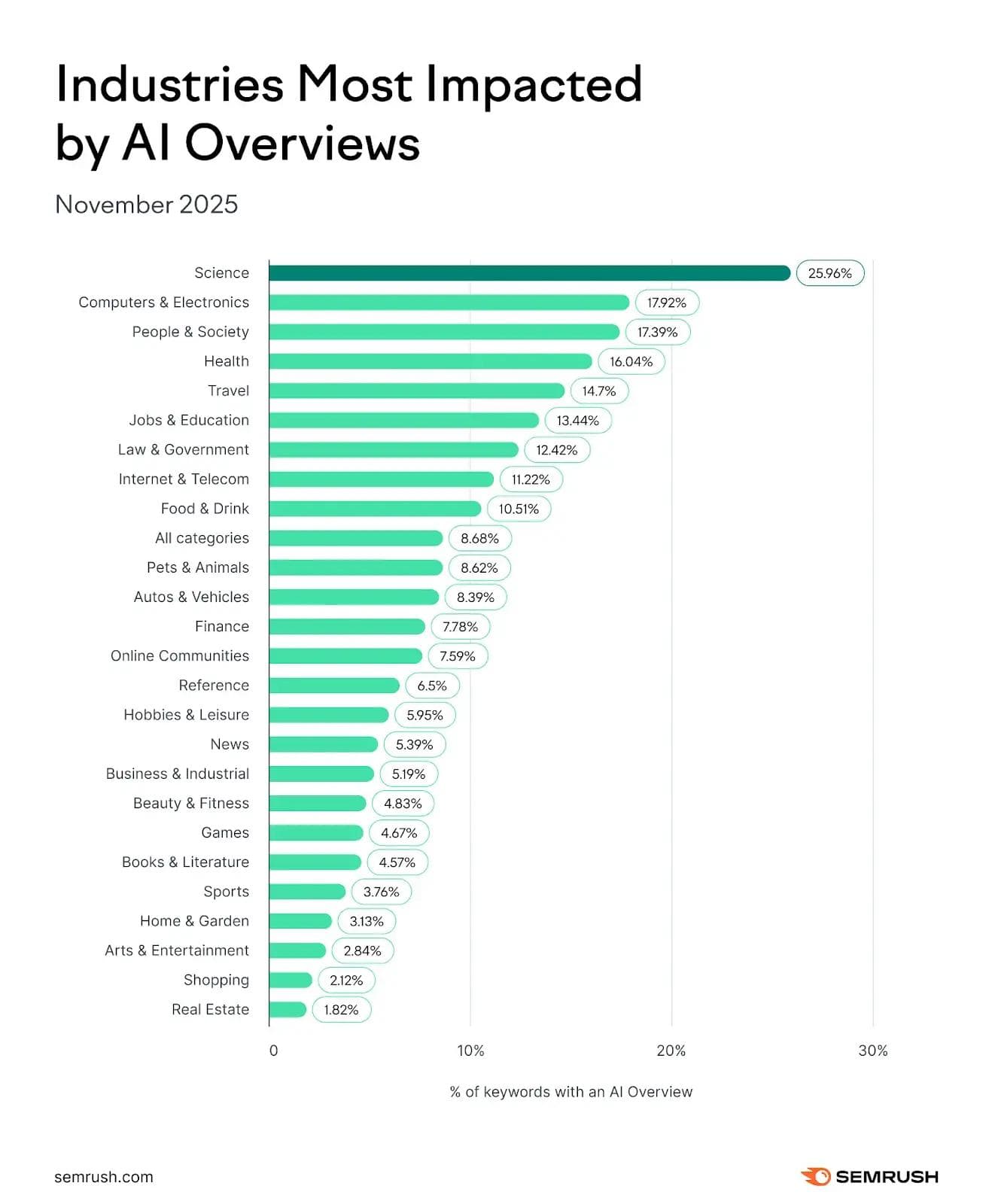
Semrush's November 2025 report puts Travel and Food & Drink above the industry average for AI Overview coverage, at 14.7% and 10.51% of keywords respectively. For hospitality brands, that means AI is already changing how potential guests discover restaurants, hotels, and destinations before they ever visit a website.
Personalisation at scale becomes possible. AI doesn’t just enable one-to-one personalisation in theory; it makes it operationally achievable. A hotel group with a unified data architecture can surface room preferences, dietary requirements, and loyalty status at every touchpoint, automatically.
Reduced friction is a competitive advantage. The brands that make it easiest for AI agents to understand, recommend, and book their offerings will win disproportionate share. This means investing in real-time data feeds, structured content, and API partnerships with the platforms where agentic booking is taking place.
Measurement will need to evolve. As bookings increasingly originate from AI interfaces rather than direct website visits, traditional analytics like page views, bounce rates, and organic rankings will tell an incomplete story. Brands will need new frameworks to understand how they are being represented within AI-generated recommendations and where they are winning or losing in agent-led search.
The hospitality brands that will thrive in this environment are those that treat AI readiness not as a technology project but as a strategic foundation — one where data quality, personalisation capability, and platform partnerships are as important as the guest experience itself.